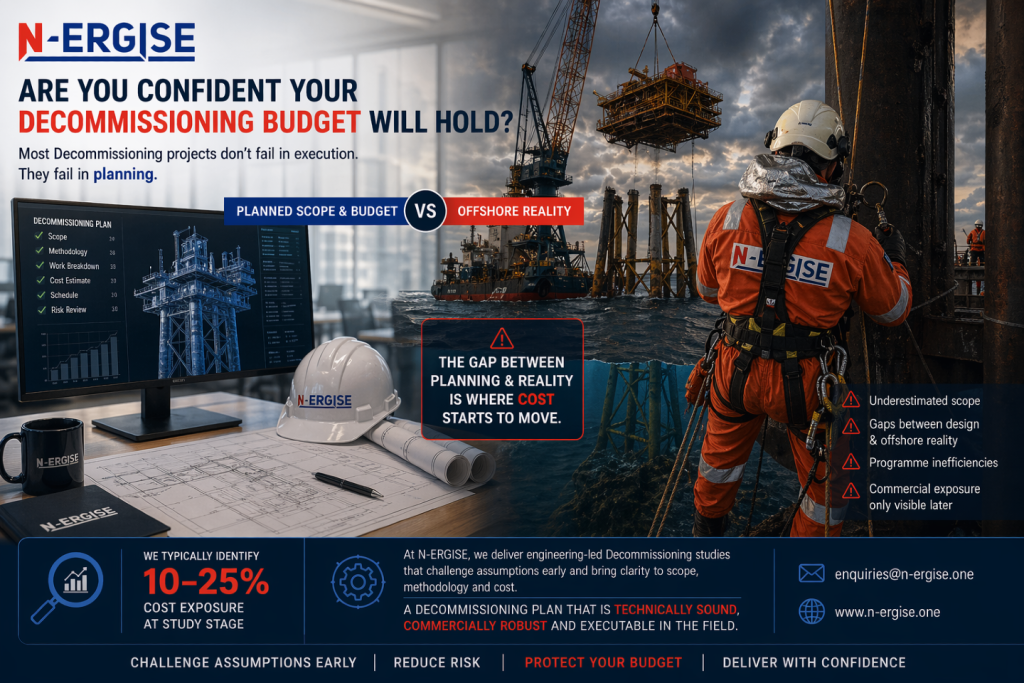
This is where cost starts to move, risk begins to build, and assumptions can quietly introduce commercial exposure that only becomes visible later in the project lifecycle.
Why Decommissioning Budgets Fail
Decommissioning budget planning is complex. Projects are influenced by uncertain asset conditions, offshore constraints and evolving methodologies. When early-stage engineering is not robust, these variables can quickly translate into cost increases.
Common causes of budget overruns include:
- Underestimated scope due to limited early-stage detail
- Gaps between design and offshore reality
- Programme inefficiencies driven by poor sequencing or planning assumptions
- Hidden commercial exposure that emerges during execution
By the time these issues are identified offshore, options to control cost are often limited.
The Gap Between Planning and Offshore Reality
One of the biggest risks in decommissioning is the disconnect between what is planned onshore and what is encountered offshore.
Engineering assumptions made without sufficient challenge can result in:
- Incorrect methodologies
- Inaccurate duration estimates
- Unexpected access constraints
- Increased offshore scope and rework
This gap is where budgets begin to break.
Engineering-Led Decommissioning Studies
At N-ERGISE, we focus on closing this gap through engineering-led decommissioning studies that challenge assumptions early and bring clarity to:
- Scope definition
- Execution methodology
- Programme planning
- Cost structure
Rather than relying on high-level assumptions, our approach ensures that plans are technically sound, commercially robust and executable in the field.
Identifying Cost Exposure Early
Through detailed study work and engineering analysis, it is common to identify 10–25% cost exposure at study stage.
Identifying this early allows project teams to:
- Refine scope and methodology
- Reduce uncertainty before execution
- Improve budget confidence
- Minimise downstream commercial risk
Without this level of scrutiny, that same exposure often remains hidden until it becomes significantly more expensive to address.
Building a Decommissioning Plan That Holds
A reliable decommissioning plan is not built on assumptions. It is built on:
- Accurate engineering data
- Realistic offshore execution strategies
- Clear understanding of constraints and risks
- Alignment between design and delivery
When these elements are in place, projects are far more likely to be delivered safely, efficiently and within budget.
Reduce Risk Before It’s Locked In
If your project is still relying on high-level assumptions, there is a strong likelihood that your decommissioning budget is already carrying risk.
Taking action at the study stage provides the opportunity to correct this before costs are fixed and exposure increases.
Work With N-ERGISE
If you want to understand where your decommissioning budget really sits — and reduce risk before execution — our team can help.
Email:enquiries@n-ergise.one
Service Page:Decommissioning Services